Elaiussa Sebaste — A Forgotten City of Cilicia by the Sea
Elaiussa Sebaste is one of Turkey’s most picturesque and least touristy ancient cities, tucked away on the Mediterranean coast in the province of Mersin, in the Erdemli district, near the modern village of Ayaş. Once upon a time, this port city was the splendid residence of the Cappadocian king Archelaus, successfully rivaled Tarsus and Coricus, exported olive oil throughout the Mediterranean, and then quietly faded away during the Byzantine era. Today, Elaiussa Sebaste is a collection of marble colonnades, basilicas, and a theater scattered among olive groves and the spray of the surf. It is the perfect spot for those who want to experience ancient Cilicia away from the crowds.
History and Origins
The city was founded in the 2nd century BCE as a small settlement on a tiny island connected to the mainland by a narrow isthmus. This naturally protected location immediately turned Elaiussa into a convenient port hub: ships from Cyprus, Phoenicia, and the Aegean coast would call here. The Greek name Elaiussa derives from the word elaion—“oil”; it reflects the region’s primary wealth—olive groves stretching for many kilometers into the Taurus Mountains.
The city underwent a decisive transformation during the reign of Emperor Augustus, when the Cappadocian king Archelaus made Elaiussa his second capital. He expanded the settlement, moving its center to the mainland, and renamed it Sebaste—the Greek equivalent of the Latin “Augusta”—in honor of the emperor. Thus, at the beginning of the 1st century CE, the city with the double name Elaiussa Sebaste came into being. Archelaus built a palace and public buildings here, expanded the port, and the city experienced its first golden age.
Under Roman Rule
After Archelaus’s death in 17 CE, Cappadocia was incorporated into the Roman Empire, and Elaiussa Sebaste became an important city in the province of Cilicia. In 74 CE, Emperor Vespasian finally cleared the Cilician coast of pirates, paving the way for a new economic boom in Sebaste. In the 1st–2nd centuries CE, construction flourished here: a theater, thermal baths, an agora, an aqueduct, and a monumental avenue of tombs were built. The city exported olive oil, cedar wood, and wine far beyond the Mediterranean.
Byzantium and Decline
From the 3rd century CE, the city began to lose its prominence. In 260 CE, the Persian king Shapur I launched a devastating campaign into Cilicia, and Sebaste suffered severe damage. Later, the inhabitants were plagued by raids by the Isaurians—mountain tribes of inner Anatolia. In the 5th–6th centuries, the city still retained its importance as a religious center: several basilicas and a bishop’s residence were built here. However, by the 6th century, the neighboring city of Korykos had taken over the role of the coast’s main port, and Elaoussa-Sebaste gradually fell into disuse. By the time of the Arab campaigns of the 7th century, the city was already a semi-abandoned ruin.
Architecture and What to See
The Elaiussa Sebaste Archaeological Park covers several dozen hectares along the D-400 highway. Today, a significant portion of the site has been excavated and transformed into an open-air museum where you can wander for hours. Sebaste’s main feature is its vibrant “layered” layout: here you’ll find Hellenistic structures, Roman baths, Byzantine basilicas, and later necropolises, all scattered across the hills overlooking the turquoise sea.
Theater
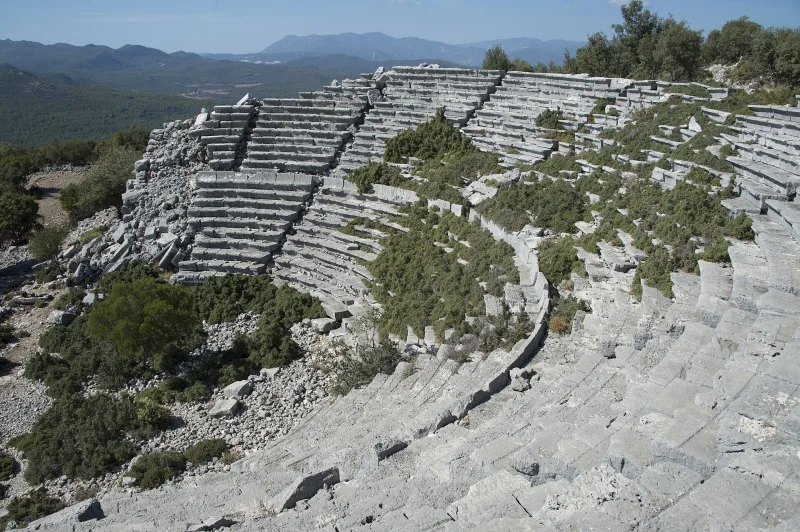
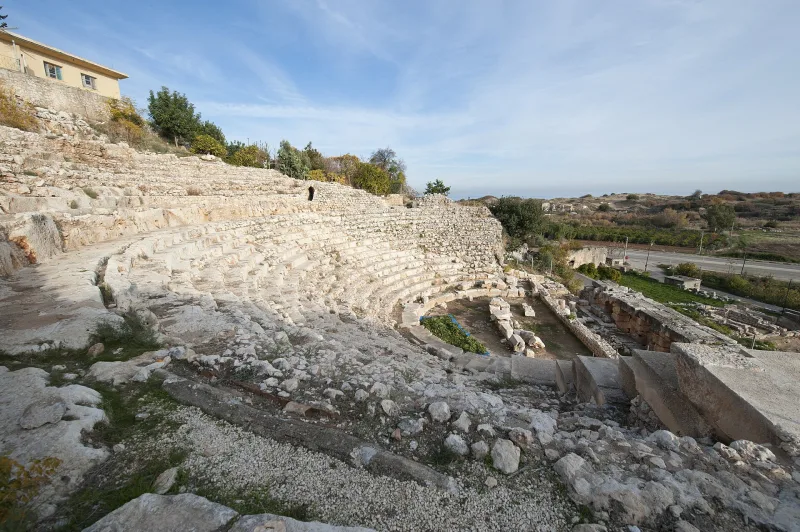
The heart of the ancient city is a small Roman theater from the 2nd century CE. It was designed to seat approximately 2,300 spectators; 23 rows of seats, the orchestra, and part of the stage have survived. The theater is partially carved into the hillside, a feature characteristic of the Hellenistic tradition. The upper rows offer a panoramic view of the sea and the remains of the ancient island—from here, it is hard to imagine that this place once bustled with life. The theater is periodically used for summer concerts and festival performances organized by the local municipality.
The Agora and the Lion Fountains
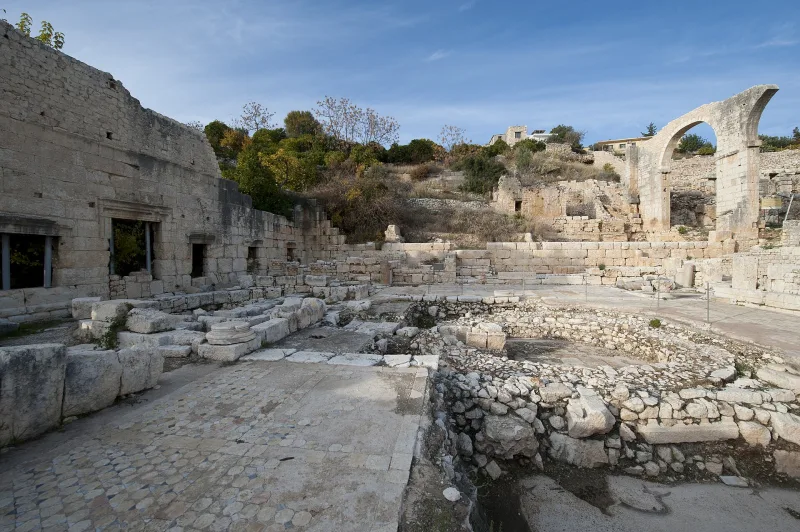
The Agora of Sebaste is one of the best-preserved forums in Cilicia. The rectangular square was surrounded by colonnades of gray marble; fragments of capitals and slabs have been preserved in situ. On the south side of the agora stands a monumental fountain with lion heads, from whose mouths water flowed—a classic architectural feature of the Roman era. Honorary statues of distinguished citizens once stood here as well; their bases still lie along the colonnade.
Thermae and Mosaics
Several complexes of public baths have preserved mosaic floors with geometric and floral patterns. Of particular interest is the large thermal complex with a frigidarium, tepidarium, and caldarium—the classic Roman sequence in which the bathing ritual took place. Some of the mosaics have been restored and are now covered by light canopies to protect them from the sun. Traces of frescoes and plasterwork remain on the walls.
Basilicas and the Byzantine Quarter
Several early Christian basilicas have been excavated within the park—structures from the 5th–6th centuries featuring apses, narthexes, and baptisteries. One of them stood on a circular foundation—a rare form for the region, inherited from Hellenistic circular temples. Adjacent to the basilica was a courtyard with a cistern, where ritual ablutions were performed during the Byzantine era. These churches are evidence that Sebaste remained an active Christian community until the very end.
The Avenue of Tombs and the Necropolis
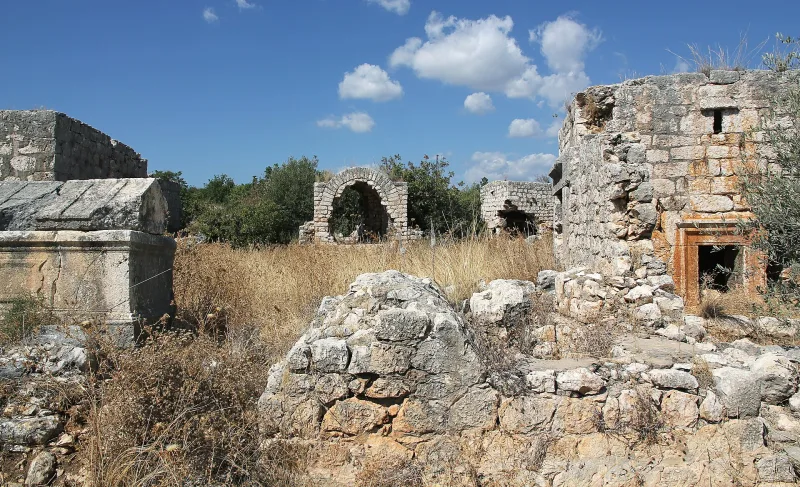
The northern part of the city opens onto the famous “Alley of Tombs”—nearly 100 monumental tombs arranged along an ancient road. Many of them are shaped like houses or temples, adorned with carved cornices and inscriptions in Greek and Latin. This is one of the largest collections of monumental tombs on Turkey’s Mediterranean coast, and a walk along the avenue itself is a deeply moving experience.
The Twelve-Column Temple and Aqueduct
At the top of the hill overlooking the sea stood a twelve-column temple, likely dedicated to the emperor and Augustus. Today, only the foundations and a few fragments of columns remain, but the site is still mesmerizing: from here, a classic “Cilician” view opens up with the sea horizon. An aqueduct ran from the inland coast to the city, supplying Sebaste with water from the Lamos River—fragments of the aqueduct’s arches can be seen a few kilometers from the park.
Interesting Facts and Legends
- The name Elaiussa comes from the Greek “elaion” — “olive oil”; this was the city’s main product, exported even to Alexandria and Rome.
- Archelaus, the king of Cappadocia who rebuilt the city during the reign of Augustus, owned his own fleet, and Elaiussa Sebaste was his “second home” far from the interior of Cappadocia.
- Greek inscriptions bearing the names of noble patrons who funded the construction have survived to this day in the city’s theater.
- Sebaste’s “Avenue of Tombs” is one of the longest “streets of the dead” in Turkey, many of whose tombs are decorated with intricate symbolism and portraits of the deceased.
- A rare mosaic depicting a peacock—a Christian symbol of immortality—was discovered in one of the early Byzantine basilicas, indicating the community’s high status.
- The city survived an earthquake in the 4th century CE, after which many buildings had to be rebuilt; traces of the restorations are visible in many of the surviving walls.
How to get there
The Elaiussa Sebaste Archaeological Park is located near the village of Ayas, in the Erdemli district of Mersin Province, approximately 55 kilometers west of the center of Mersin and 24 kilometers east of the resort town of Kızkalesi. The easiest way to get there is by car via Highway D-400, which runs along the entire coast: the park is located right off the road, and you can enter it from the parking lot marked with “Elaiussa Sebaste” signs.
Regular dolmuşes run from Mersin and Silifke: the “Ayaş” stop is located 200 meters from the entrance to the archaeological park. The distance from Adana Şakirpaşa Airport to Sebaste is about 130 kilometers (1.5–2 hours by car). Many tourists base themselves in Kız Kalesi and come here on a half-day excursion, combining the visit with a tour of Kız Kalesi and the underground city of Kanıtalı. Parking at Sebaste is free and spacious.
Tips for travelers
The best time to visit Elaiussa Sebaste is in the spring (March–May) and fall (September–November). In the summer, the sun beats down hard in the open areas, there is almost no shade, and temperatures often exceed 35 °C. In winter, Cilicia is warm and sunny, and the park is especially pleasant during these months: empty paths, soft lighting, and few other tourists. A leisurely tour of the entire site takes 2–3 hours. A park ticket costs about 80–100 Turkish lira; the Müzekart is accepted.
Bring water, a hat, comfortable shoes, and sunscreen. There are no cafes or kiosks on the grounds; the nearest places to eat are in the village of Ayas and in Kizkalesi. Sebaste is especially beautiful in the morning and an hour before sunset, when the slanting rays highlight the contours of the marble colonnades and tombs. Drones are prohibited without permission.
Elaiussa Sebaste pairs perfectly with other monuments along the Cilician coast. In a single day, you can visit Kanytellis with its basilicas and necropolises, the “Castle on Land and Sea” (Kızkalesi), the “Hell and Paradise” (Cennet ve Cehennem), and Uzuncaburç—the best-preserved ancient sanctuary of Zeus in Cilicia. If you have two days, base yourself in Kızkalesi and take two day trips: one along the coast, the other deep into the mountains. Beach lovers should know that there is a small pebble beach right at the park entrance—after a walk through the ancient ruins, it’s nice to take a dip in the Mediterranean Sea. Sebaste (Elaiussa Sebaste) is one of those rare sites in Turkey where you can almost touch history with your own hands, and the sea laps right up against the very walls of the ancient baths.